Hi all,
Want to share this new(ish) paper from @ralphpeterson, “Computational Urban Ecology of New York City Rats”
https://www.biorxiv.org/content/10.1101/2025.07.21.665423v1
Figure 7 uses VocalPy! 
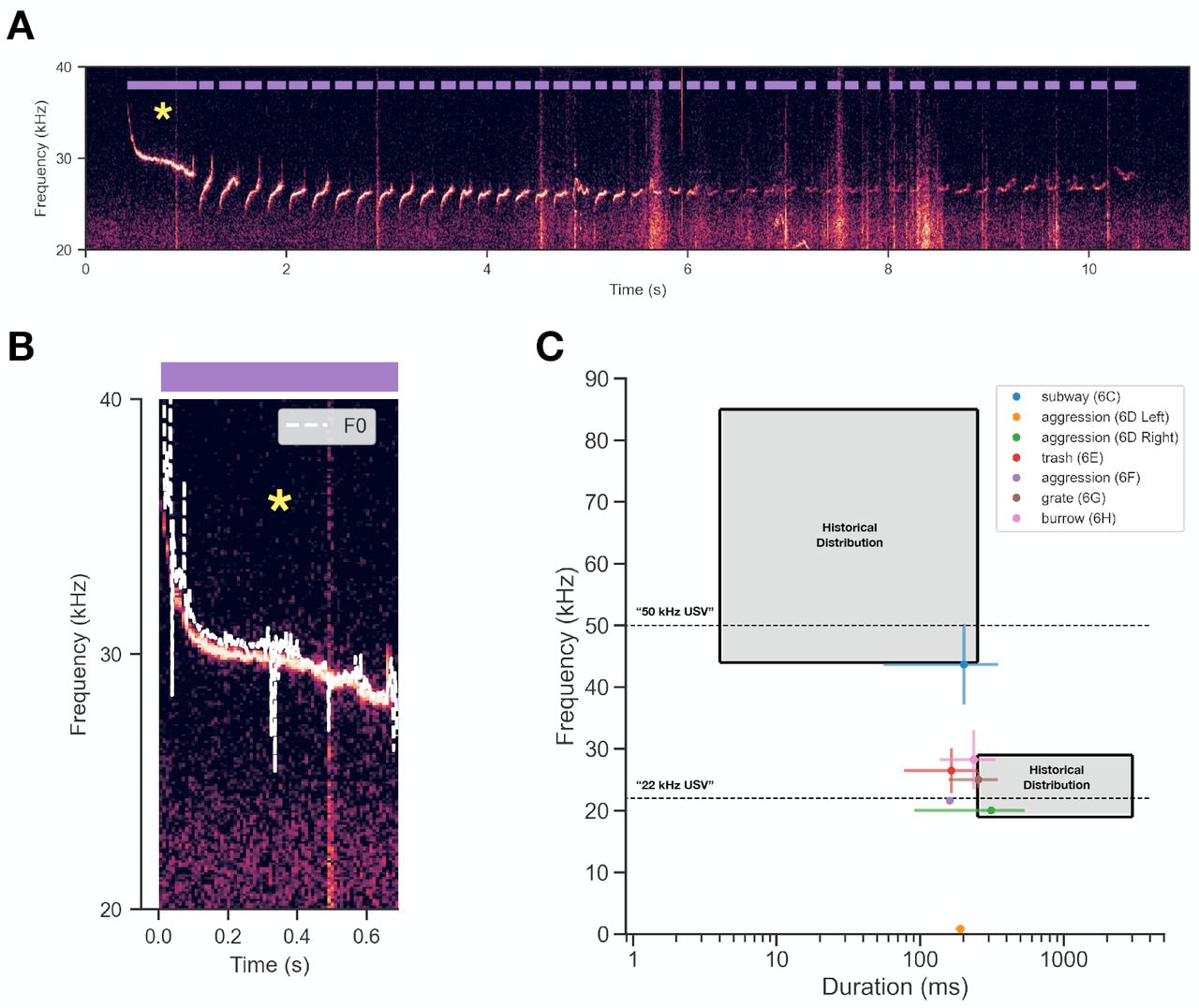
This is a step up from being in the supplementary figures of a previous paper from @ralphpeterson  We’ll take it!
Really interesting findings here, too.
From results:
We find that wild NYC rat vocalizations are consistently shorter duration and lie outside of the historical frequency-duration range reported in the meta-analysis.
And discussion:
The ultrasonic vocalizations (USVs) reported here raise questions about their function in rat social behavior and challenge traditional assumptions about vocal behaviors observed in the laboratory. USVs are primarily studied in lab environments and there have been few attempts to understand vocal repertoire diversity and social function in wild rats, though the artist Brian House recorded rat ultrasonic vocalizations in NYC for a 2022 sound installation [26]. The biological function of USVs in rodents generally is still largely unknown, but since ultrasound decays rapidly with distance, one can speculate that they may be emitted in close proximity to enhance social interactions. They might also be used as a cue to localize nearby conspecifics or to report your current location like in bats [31]. An intriguing theory proposes that since ultrasound causes agglomeration of particles in the air like odorants, rodents have evolved an active sampling mechanism which couples USVs with increases in sniffing [67] to enhance the perception of pheromones. If this were true, it would help explain why we see USVs in such diverse contexts, such as within trash bags.
It is generally thought that 22 and 50 kHz vocalizations signal aversive and appetitive contexts, respectively [8]. Here, we observe that 22 kHz vocalizations are used in diverse contexts, some of which are seemingly not aversive. For example, a long bout of near-22 kHz USVs was emitted while a single rat foraged inside of a trash bag (Figure 6E). Rats have not been reported to emit 22 kHz vocalizations while foraging in laboratory settings; instead, studies have shown that 22 kHz calls actually suppress feeding behavior [7]. An alternative theory postulates that 22kHz calls could serve a security function — that is, to signal potential threat (though unperceived) in unpredictable environments [8]. Our “Sidewalk” data (Figure 6E,G,H) provide intriguing validation of this theory, where 22 kHz vocalizations are observed in highly unpredictable urban sidewalks in the absence of overt predatory threat. The acoustics of wild rat vocalizations appear to be relatively out of distribution as compared to classically recorded lab rat vocalizations, with 22 kHz vocalizations notably shorter in duration (6E,G,H; Figure 7C). Moreover, we observed numerous vocalizations that had power in the human audible range (“squeaks”) (6D,F). Future studies should focus on the social function of squeaks in wild rats, as most rat vocalization research has focused on USVs. This direction has been promising in wild mice, with recent work revealing that squeaks are genetically heritable and used seasonally [27, 28]. More recordings in more contexts over longer timescales are required to make concrete claims about the biological function of rat vocalizations in an urban setting.
Also the rest of the paper is really cool and you should read it, not that I’m biased 